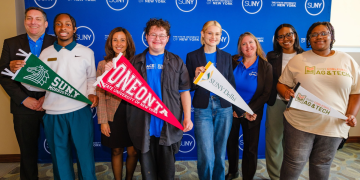
On a small, close-knit campus, people look out for each other. A professor notices a student who hasn’t been to class. A coach sees a change in an athlete’s behavior. A colleague notices something off in a coworker’s tone. When these moments happen, does the person witnessing them feel equipped to do something about it?
That was the question the Wellness Center’s staff set out to answer when they launched Mental Health First Aid training on campus in 2023, made possible through Higher Education Emergency Relief Fund (HEERF) funding that allowed the college to invest in campuswide mental health program during the COVID-19 pandemic.
Since then, more than 370 employees and students have completed the full-day training, and have created a campus network of informed, empowered individuals who know how to recognize the signs of a mental health crisis and, crucially, feel confident responding to one.
“The training has opened the conversation on mental health,” said Lynn Ontl, Director of the Wellness Center. “It breaks away from the stigma that has historically surrounded these issues and gives people a real, practical way to show up for someone who’s struggling.”
Mental Health First Aid is a nationally recognized, evidence-based curriculum developed by people with lived experience of mental health challenges alongside clinical professionals. The course teaches early intervention techniques and improves mental health literacy, helping participants understand, identify, and respond to signs and symptoms of a mental health or substance use crisis.
The training gives them the confidence to compassionately engage that person and guide them to the appropriate resources. These are the skills that can make an important difference in those moments before a crisis escalates. Each participant who completes the training receives a certification as a Mental Health First Aider, valid for three years.
“Those who have completed the training consistently describe feeling more confident that they know how to help when they encounter someone in distress,” said Kristyn Esposito, a Senior Counselor at the College. “That so many across campus have participated speaks to how deeply ‘care’ is woven into our culture, not siloed within the Wellness Center, but extending outward into every corner of college life.”
All Athletics coaches at the College are now trained in Mental Health First Aid. The Wellness Center has also taken proactive steps in the athletic department, conducting annual mental health screenings of student athletes to identify early signs of distress. Student athletes who score above a certain threshold through the screening are connected to Wellness staff for support to address what the assessment has surfaced. It is preventive care before a crisis has a chance to form, and it has brought the Wellness Center into a closer, more integrated relationship with the Athletics program.
The reach of training program has now even extended beyond campus. Wellness staff have trained county health officials and staff at another SUNY institution, bringing the College’s expertise to the wider community.
In January 2026, SUNY announced a system-wide Mental Health First Aid Grant Program to expand training across its 64 campuses, building on the model SUNY Cobleskill Ag & Tech introduced when it became one of the first institutions in the system to make the training a campuswide priority.