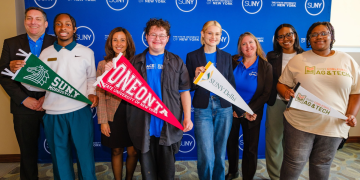
Fourteen SUNY Cobleskill Ag & Tech students traded their classroom for the African bush this May, embarking on a two-week study abroad journey to South Africa with EcoLife Expeditions. The experience that brought their wildlife conservation and veterinary science learning to life and immersed them in field work with species and environments you can’t find here at home.
Participating students completed a seminar course prior to the trip, covering South African wildlife biology and ecology, local culture, and international travel logistics. That preparation let them hit the ground running, first with a behind-the-scenes tour of the Johannesburg Wildlife Veterinary Hospital. Meeting the staff and seeing the active cases at the hospital gave students an immediate look at the realities of wildlife medicine.
From there, the group headed north toward the town of Warmbaths and the Klein Kariba Resort. Over the following two days, students rolled up their sleeves alongside a local veterinarian, assisting directly with game capture and wildlife care procedures in the field – the kind of hands-on experience that no lecture hall can fully replicate.
Day 5 brought one of the trip’s most emotionally resonant stops: the Rhino Connect Sanctuary, where students had the chance to bottle-feed rhino calves and learn about the sanctuary’s ongoing conservation mission. That afternoon, the group visited the Bambelela Vervet Monkey Rehabilitation Project to see how staff work to treat injured and orphaned monkeys and return them safely to the wild.
Few experiences rival a day inside the legendary Kruger National Park, and students got to live it. After traveling further north to the Punda Maria Rest Camp at the park’s northern reaches, students spent a full day exploring the park by expedition bus under the guidance of their EcoLife guides, spotting wildlife across one of Africa’s most diverse local ecosystems.
From Kruger National Park, the group traveled to the Swadini Resort within the Blyde River Canyon Nature Reserve. There, students spent two days immersed in a local wildlife veterinarian’s One Health program, assisting with wildlife work in the field within the program that also examines the interconnectedness of human, animal, and environmental health.
A standout moment came during a visit to a K9 Anti-Poaching Unit, where students met the working dogs, examined snares and other tools used by poachers, and gained a new understanding of the daily fight against illegal poaching. The group also joined HALO veterinary outreach volunteers in a rural settlement near Hoedspruit to provide care to domestic animals in an underserved community.
Students even took to the air, getting the chance to practice helicopter dart-shooting, first firing on the ground at a stationary target, and then from a helicopter in flight, learning the techniques used in wildlife immobilization operations. Renowned conservationist Professor Wouter van Hoven also joined the group for a lecture workshop at Swadini, presenting on wildlife reserve management and conservation strategy.
“There is no substitute for putting students in the field alongside professionals who do this work every day,” said Eric Struening, Instructional Support Technician and faculty advisor on the trip. “What makes this experience so powerful is the breadth of activities we were able to fit into a two-week trip. Students touched nearly every corner of the field: wildlife medicine, conservation strategy, community outreach, and anti-poaching efforts. It gives all of us a 360-degree view of the urgent and interconnected challenges these fields exist to address.”
The journey wrapped with a morning at the Hoedspruit Reptile Center, where students completed a reptile orientation course before returning to camp to take a final exam. That evening, all gathered for a graduation ceremony celebrating everything they had learned and accomplished. The group departed Johannesburg on May 25, bringing back with them memories for a lifetime and a stronger professional foundation in their chosen career field.
Students and faculty members who completed the expedition are: Ariana Astacio, Javante Brill-Rollins, Bella Case, Olivia Chromczak, Ella Dillman, Julia Dunn, Sarah Harrison, Jen Kaplan, Maggie Lee, Madelena Macaluso, Amelia Mattia, Haley McKernan, Amanda Ogden, Alexandra Wallace, Dana Weir (Faculty), Eric Struening (Faculty).
See all the photos from the trip at EcoLife Expeditions Facebook page.
Student reflections
“My experience on the South Africa trip was unbelievable, and every moment was breathtaking,” said Sarah Harrison, a senior Animal Science B.S. major. “As someone who is passionate about animals and aspires to be a veterinarian, this was a trip of a lifetime for me because I got to learn and try so many new things I never thought I would do. The most valuable takeaway from this trip is that every day can be a new opportunity if you learn to embrace it. This trip has become an unforgettable memory for me and has strengthened my desire to be a veterinarian.”
“Studying abroad was life-changing for me,” said Amanda Ogden, a senior Animal Science B.S. major. “As someone who had never left the country before, I could never have imagined that South Africa would be my first experience abroad. The hands-on experience and knowledge I gained from this trip with wildlife experts and veterinary professionals are things a textbook could never teach, and I will carry these moments throughout my pursuit of becoming a veterinarian. This trip gave me the confidence to travel and solidified that I belong in the world of veterinary medicine.”
“South Africa was an incredible opportunity to take what I’ve learned and apply it in a completely new manner,” said Javante Brill-Rollins, a sophomore Animal Science B.S. student. “I was able to get hands-on experience with animals that I’d never be able to at home and got to hear first-hand accounts from international veterinarians. This is an experience I won’t soon forget, and I am deeply thankful for this journey.”
“The two weeks I spent in South Africa with my classmates were truly a once-in-a-lifetime experience,” said Amelia Mattia, a junior Animal Science B.S. major. “I was able to get incredible opportunities with wildlife veterinarians, gaining hands-on experience with Sable antelope, zebra, and even a black impala. One day, our group visited a Rhino rescue and rehabilitation center where I got to see a rhino in its natural habitat and learn all about the conservation efforts. I made connections with people across the world, and I will forever be grateful for everything I learned. I left South Africa feeling inspired to keep exploring and learning new things.”